Granny Flat Rules Victoria — Planning Permits, Building Standards and What's Changed
Victoria reformed its granny flat framework between 2023 and 2026. Most homeowners on lots over 300sqm no longer need a planning permit — but building standards are stricter than any other state.
Key changes to Victorian granny flat rules
No planning permit for most builds
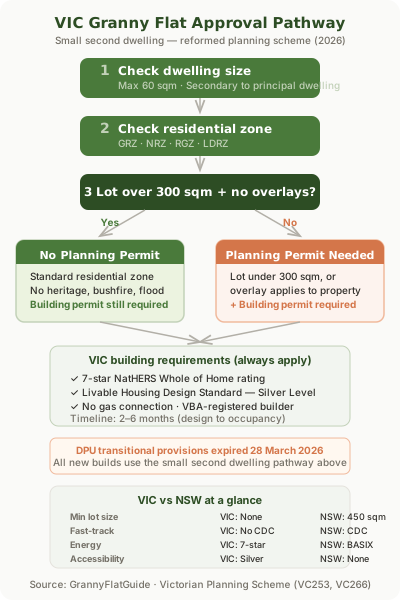
Since December 2023, homeowners on lots over 300sqm in standard residential zones (GRZ, NRZ, RGZ, LDRZ) no longer need a planning permit for a small second dwelling under 60sqm — provided no overlays apply.
Stricter building standards
Victoria requires a 7-star NatHERS Whole of Home energy rating, Livable Housing Design Standard Silver Level compliance, and prohibits gas connections. These add $5,000–$15,000 to build costs compared to other states.
DPU framework wound down
The Dependent Person's Unit transitional provisions expired on 28 March 2026 (VC266). All new granny flats follow the small second dwelling pathway — no dependent person requirement, no removal obligation.
Rent to anyone
No occupancy restrictions apply. You can rent your granny flat to family, friends, or the general market. Standard residential tenancy laws apply. Short-term rental attracts Victoria's short-stay levy (from 1 January 2025).
Victoria's granny flat rules have changed significantly. Between December 2023 and March 2026, a series of planning scheme amendments — VC253, VC259, VC266, and VC282 — removed the old Dependent Person's Unit restrictions and established a more flexible "small second dwelling" framework. Most homeowners on residential lots over 300sqm can now build a granny flat up to 60sqm without a planning permit, though building permit, energy, and accessibility requirements still apply.
This guide covers the current Victorian rules as of April 2026: what you can build, when you need a planning permit, the building standards that apply, how Victoria compares to NSW, and what you should check before engaging a builder.
Victoria's granny flat framework — the current rules
Victoria overhauled its granny flat framework through a series of planning scheme amendments between December 2023 and March 2026. The result is a system that is more permissive than before — but still materially different from the NSW CDC pathway.
The official Victorian planning term is "small second dwelling." If you've heard the term "Dependent Person's Unit" (DPU), that framework has been wound down — the transitional provisions under Amendment VC266 expired on 28 March 2026. All new granny flat builds in Victoria now follow the small second dwelling pathway.
What you can build
A small second dwelling in Victoria must be:
- 60sqm or less in floor area
- Secondary to the principal dwelling on the lot
- Self-contained (kitchen, bathroom, living, and sleeping areas)
- Constructed by a VBA-registered builder
Unlike NSW, Victoria has no minimum lot size requirement in planning law. Your key constraints are your zone, any overlays that apply to your property, and whether you can meet the building standards.
Do you need a planning permit?
For most homeowners on lots over 300sqm in a standard residential zone, the answer is no. Amendment VC253 (December 2023) removed the planning permit requirement for small second dwellings in the following zones:
- General Residential Zone (GRZ)
- Neighbourhood Residential Zone (NRZ)
- Residential Growth Zone (RGZ)
- Low Density Residential Zone (LDRZ)
The catch: overlays. Even if your lot meets the zone and size criteria, a planning permit is still required if any of these overlays apply:
- Heritage Overlay (HO)
- Bushfire Management Overlay (BMO)
- Land Subject to Inundation Overlay (LSIO) or Special Building Overlay (SBO)
- Significant Landscape Overlay (SLO)
You can check which overlays apply to your property using VicPlan, the Victorian Government's free planning map tool. Search your address, and the overlays will be listed under the property information panel.
If your property is in a zone not listed above — such as a Mixed Use Zone or Township Zone — check your council's planning scheme for secondary dwelling provisions.
Building permit — always required
Regardless of whether you need a planning permit, a building permit is always required in Victoria. This is issued by a registered building surveyor (private or municipal) and confirms the build meets the National Construction Code (NCC) and all Victorian building regulations.
Victoria imposes several requirements that other states do not:
7-star NatHERS Whole of Home rating. Under NCC 2022, all new Class 1a dwellings in Victoria — including small second dwellings — must achieve a minimum 7-star Whole of Home energy rating. This affects insulation levels, glazing specifications, and orientation.
Livable Housing Design Standard — Silver Level. Victoria mandates Silver Level compliance for all new small second dwellings. In practice, this means:
- Step-free entry (flush thresholds)
- Wider doorways (minimum 820mm clear opening)
- Wider corridors
- An accessible toilet on the entry level
- Reinforced bathroom walls for future grabrail installation
These requirements shift design and cost — particularly for compact footprints where every centimetre matters. A 40sqm studio designed to Livable Housing Silver will have different internal proportions than one designed without these requirements.
No gas connection. Small second dwellings cannot connect to reticulated natural gas under Victoria's Gas Substitution Roadmap. All cooking, hot water, and heating must be electric.
What happened to DPUs?
The Dependent Person's Unit was Victoria's historical granny flat framework. A DPU required the occupant to be a "person dependent on the resident of the existing dwelling" — typically an elderly parent or a person with a disability. The DPU had to be removed or converted back when the dependent person no longer lived there.
Amendment VC253 introduced the broader small second dwelling provisions in December 2023. DPU transitional provisions under VC266 expired on 28 March 2026. As of April 2026:
- You cannot establish a new DPU
- Existing DPUs that were lawfully established continue as existing use
- All new secondary dwellings follow the small second dwelling pathway — no dependent person requirement, no removal obligation
This is a significant change. Victoria now allows granny flats that can be rented to anyone, used by family, or left vacant — the same flexibility as NSW and QLD.
Renting out your Victorian granny flat
There are no occupancy restrictions on small second dwellings in Victoria. You can rent to anyone — family, friends, or the general market. Standard residential tenancy laws under the Residential Tenancies Act 1997 apply.
If you're considering short-term rental accommodation (Airbnb, Stayz), be aware of Victoria's short-stay levy, which took effect on 1 January 2025. The levy applies to stays under 28 consecutive days and is administered by the State Revenue Office.
For detailed cost analysis and rental yield comparisons, see our granny flat building costs guide.
How VIC compares to NSW
Victoria and NSW are the two most active granny flat markets in Australia, but the rules differ in several ways:
| Factor | Victoria | NSW | |---|---|---| | Max floor area | 60sqm | 60sqm | | Min lot size | None | 450sqm (CDC) | | Fast-track approval | No CDC equivalent | CDC via private certifier | | Building permit | Always required | Construction Certificate + OC | | Energy rating | 7-star NatHERS | BASIX certificate | | Accessibility | Livable Housing Silver | Not required | | Gas connection | Not permitted | Permitted | | Occupancy restrictions | None | None |
The biggest practical difference: NSW has the CDC pathway, which gives a defined fast-track approval through a private certifier (10–20 business days). Victoria has no equivalent — the building permit process typically takes 2–4 weeks for straightforward builds, but there is no statutory timeframe equivalent to a CDC. For a detailed comparison of fast-track versus standard approval, see our CDC vs DA approval guide.
Typical timeline and costs
A straightforward Victorian granny flat build typically follows this timeline:
- Design and planning: 4–8 weeks (longer if planning permit needed)
- Building permit: 2–4 weeks
- Construction: 12–20 weeks depending on build type and complexity
A turnkey granny flat in Victoria typically costs between $130,000 and $220,000 GST-inclusive for a standard 1–2 bedroom build on a flat, accessible site. The 7-star NatHERS and Livable Housing requirements can add $5,000–$15,000 compared to equivalent builds in states without these standards (based on industry estimates; last checked April 2026). Budget a 10% contingency ($13,000–$22,000) on top of any estimate.
For detailed cost breakdowns using the four-bucket model, see our granny flat building costs guide. To compare quotes from granny flat builders serving Victoria, get free quotes through our comparison platform.
What to check before you start
Before engaging a builder or designer, verify these three things:
- Your zone and overlays — Use VicPlan to confirm your property is in a residential zone and identify any overlays
- Your builder's registration — Check the VBA practitioner register at vba.vic.gov.au to confirm your builder holds current registration
- Your lot constraints — A site survey will identify practical constraints (slope, access, existing trees, setbacks to boundaries) that affect design and cost
For state-by-state comparisons of granny flat rules across Australia, including WA's distinct R-Codes framework, see our state guides.
GrannyFlatGuide provides independent information to help you understand the granny flat building process. This is not legal, planning, or building advice. Regulations change, and requirements vary by council. Always verify current requirements with your local council or a qualified town planner before making decisions.
Granny flat builders in Australia
Browse profiles, compare service areas, and check reviews.

Garden Studios
★ 5.0 (63 reviews)
View profile →

Perway Ecopods
★ 5.0 (43 reviews)
Perth-based home renovation and construction company offering custom builds with transparent service.
View profile →

Out-Back Portable Buildings
★ 5.0 (25 reviews)
Custom-made, pre-fabricated transportable homes including granny flats, offices, and portable buildings.
View profile →

Adams Cabins
★ 5.0 (20 reviews)
Family-owned cabin builders specializing in log cabins, granny flats, and tiny homes in SE Queensland.
View profile →

ATN Constructions
★ 5.0 (18 reviews)
View profile →

Dare Constructions
★ 5.0 (16 reviews)
Steel frame construction specialist including granny flats, carports, sheds across Newcastle, Hunter Valley, and Sydney.
View profile →
GrannyFlatGuide is a comparison platform. Companies shown are filtered by relevance to this page. Listing does not imply endorsement. GrannyFlatGuide may receive a referral fee when you request quotes.
Put this into action
Check your property’s zoning and approval pathway, then connect with verified builders when you’re ready.
What can you build on your property?
Enter your address and we'll check your zoning, overlays, and what's possible on your block.
We use your address to check council zoning and planning rules — not stored until you choose to continue.
Victoria's granny flat rules have changed significantly. Between December 2023 and March 2026, a series of planning scheme amendments — VC253, VC259, VC266, and VC282 — removed the old Dependent Person's Unit restrictions and established a more flexible "small second dwelling" framework. Most homeowners on residential lots over 300sqm can now build a granny flat up to 60sqm without a planning permit, though building permit, energy, and accessibility requirements still apply.
This guide covers the current Victorian rules as of April 2026: what you can build, when you need a planning permit, the building standards that apply, how Victoria compares to NSW, and what you should check before engaging a builder.
Victoria's granny flat framework — the current rules
Victoria overhauled its granny flat framework through a series of planning scheme amendments between December 2023 and March 2026. The result is a system that is more permissive than before — but still materially different from the NSW CDC pathway.
The official Victorian planning term is "small second dwelling." If you've heard the term "Dependent Person's Unit" (DPU), that framework has been wound down — the transitional provisions under Amendment VC266 expired on 28 March 2026. All new granny flat builds in Victoria now follow the small second dwelling pathway.
What you can build
A small second dwelling in Victoria must be:
- 60sqm or less in floor area
- Secondary to the principal dwelling on the lot
- Self-contained (kitchen, bathroom, living, and sleeping areas)
- Constructed by a VBA-registered builder
Unlike NSW, Victoria has no minimum lot size requirement in planning law. Your key constraints are your zone, any overlays that apply to your property, and whether you can meet the building standards.
Do you need a planning permit?
For most homeowners on lots over 300sqm in a standard residential zone, the answer is no. Amendment VC253 (December 2023) removed the planning permit requirement for small second dwellings in the following zones:
- General Residential Zone (GRZ)
- Neighbourhood Residential Zone (NRZ)
- Residential Growth Zone (RGZ)
- Low Density Residential Zone (LDRZ)
The catch: overlays. Even if your lot meets the zone and size criteria, a planning permit is still required if any of these overlays apply:
- Heritage Overlay (HO)
- Bushfire Management Overlay (BMO)
- Land Subject to Inundation Overlay (LSIO) or Special Building Overlay (SBO)
- Significant Landscape Overlay (SLO)
You can check which overlays apply to your property using VicPlan, the Victorian Government's free planning map tool. Search your address, and the overlays will be listed under the property information panel.
If your property is in a zone not listed above — such as a Mixed Use Zone or Township Zone — check your council's planning scheme for secondary dwelling provisions.
Building permit — always required
Regardless of whether you need a planning permit, a building permit is always required in Victoria. This is issued by a registered building surveyor (private or municipal) and confirms the build meets the National Construction Code (NCC) and all Victorian building regulations.
Victoria imposes several requirements that other states do not:
7-star NatHERS Whole of Home rating. Under NCC 2022, all new Class 1a dwellings in Victoria — including small second dwellings — must achieve a minimum 7-star Whole of Home energy rating. This affects insulation levels, glazing specifications, and orientation.
Livable Housing Design Standard — Silver Level. Victoria mandates Silver Level compliance for all new small second dwellings. In practice, this means:
- Step-free entry (flush thresholds)
- Wider doorways (minimum 820mm clear opening)
- Wider corridors
- An accessible toilet on the entry level
- Reinforced bathroom walls for future grabrail installation
These requirements shift design and cost — particularly for compact footprints where every centimetre matters. A 40sqm studio designed to Livable Housing Silver will have different internal proportions than one designed without these requirements.
No gas connection. Small second dwellings cannot connect to reticulated natural gas under Victoria's Gas Substitution Roadmap. All cooking, hot water, and heating must be electric.
What happened to DPUs?
The Dependent Person's Unit was Victoria's historical granny flat framework. A DPU required the occupant to be a "person dependent on the resident of the existing dwelling" — typically an elderly parent or a person with a disability. The DPU had to be removed or converted back when the dependent person no longer lived there.
Amendment VC253 introduced the broader small second dwelling provisions in December 2023. DPU transitional provisions under VC266 expired on 28 March 2026. As of April 2026:
- You cannot establish a new DPU
- Existing DPUs that were lawfully established continue as existing use
- All new secondary dwellings follow the small second dwelling pathway — no dependent person requirement, no removal obligation
This is a significant change. Victoria now allows granny flats that can be rented to anyone, used by family, or left vacant — the same flexibility as NSW and QLD.
Renting out your Victorian granny flat
There are no occupancy restrictions on small second dwellings in Victoria. You can rent to anyone — family, friends, or the general market. Standard residential tenancy laws under the Residential Tenancies Act 1997 apply.
If you're considering short-term rental accommodation (Airbnb, Stayz), be aware of Victoria's short-stay levy, which took effect on 1 January 2025. The levy applies to stays under 28 consecutive days and is administered by the State Revenue Office.
For detailed cost analysis and rental yield comparisons, see our granny flat building costs guide.
How VIC compares to NSW
Victoria and NSW are the two most active granny flat markets in Australia, but the rules differ in several ways:
| Factor | Victoria | NSW | |---|---|---| | Max floor area | 60sqm | 60sqm | | Min lot size | None | 450sqm (CDC) | | Fast-track approval | No CDC equivalent | CDC via private certifier | | Building permit | Always required | Construction Certificate + OC | | Energy rating | 7-star NatHERS | BASIX certificate | | Accessibility | Livable Housing Silver | Not required | | Gas connection | Not permitted | Permitted | | Occupancy restrictions | None | None |
The biggest practical difference: NSW has the CDC pathway, which gives a defined fast-track approval through a private certifier (10–20 business days). Victoria has no equivalent — the building permit process typically takes 2–4 weeks for straightforward builds, but there is no statutory timeframe equivalent to a CDC. For a detailed comparison of fast-track versus standard approval, see our CDC vs DA approval guide.
Typical timeline and costs
A straightforward Victorian granny flat build typically follows this timeline:
- Design and planning: 4–8 weeks (longer if planning permit needed)
- Building permit: 2–4 weeks
- Construction: 12–20 weeks depending on build type and complexity
A turnkey granny flat in Victoria typically costs between $130,000 and $220,000 GST-inclusive for a standard 1–2 bedroom build on a flat, accessible site. The 7-star NatHERS and Livable Housing requirements can add $5,000–$15,000 compared to equivalent builds in states without these standards (based on industry estimates; last checked April 2026). Budget a 10% contingency ($13,000–$22,000) on top of any estimate.
For detailed cost breakdowns using the four-bucket model, see our granny flat building costs guide. To compare quotes from granny flat builders serving Victoria, get free quotes through our comparison platform.
What to check before you start
Before engaging a builder or designer, verify these three things:
- Your zone and overlays — Use VicPlan to confirm your property is in a residential zone and identify any overlays
- Your builder's registration — Check the VBA practitioner register at vba.vic.gov.au to confirm your builder holds current registration
- Your lot constraints — A site survey will identify practical constraints (slope, access, existing trees, setbacks to boundaries) that affect design and cost
For state-by-state comparisons of granny flat rules across Australia, including WA's distinct R-Codes framework, see our state guides.
GrannyFlatGuide provides independent information to help you understand the granny flat building process. This is not legal, planning, or building advice. Regulations change, and requirements vary by council. Always verify current requirements with your local council or a qualified town planner before making decisions.
Granny flat builders in Australia
Browse profiles, compare service areas, and check reviews.
Garden Studios
★ 5.0 (63 reviews)
View profile →
Perway Ecopods
★ 5.0 (43 reviews)
Perth-based home renovation and construction company offering custom builds with transparent service.
View profile →
Out-Back Portable Buildings
★ 5.0 (25 reviews)
Custom-made, pre-fabricated transportable homes including granny flats, offices, and portable buildings.
View profile →
Adams Cabins
★ 5.0 (20 reviews)
Family-owned cabin builders specializing in log cabins, granny flats, and tiny homes in SE Queensland.
View profile →
ATN Constructions
★ 5.0 (18 reviews)
View profile →
Dare Constructions
★ 5.0 (16 reviews)
Steel frame construction specialist including granny flats, carports, sheds across Newcastle, Hunter Valley, and Sydney.
View profile →
GrannyFlatGuide is a comparison platform. Companies shown are filtered by relevance to this page. Listing does not imply endorsement. GrannyFlatGuide may receive a referral fee when you request quotes.
Put this into action
Check your property’s zoning and approval pathway, then connect with verified builders when you’re ready.
What can you build on your property?
Enter your address and we'll check your zoning, overlays, and what's possible on your block.
We use your address to check council zoning and planning rules — not stored until you choose to continue.
Frequently asked questions
In most cases, no. Since December 2023 (Amendment VC253), a planning permit is not required for a small second dwelling under 60sqm on a lot over 300sqm in a General Residential, Neighbourhood Residential, Residential Growth, or Low Density Residential Zone — provided no overlays apply. If your lot is under 300sqm or has overlays (heritage, bushfire, flooding, significant landscape), a planning permit is still required.
60sqm. This is the maximum floor area for a small second dwelling under the Victorian planning scheme. If you need more than 60sqm, you may be looking at a dual occupancy — a different planning framework with longer approvals and higher costs.
The DPU framework has been wound down. DPU transitional provisions under Amendment VC266 expired on 28 March 2026. New granny flats are now built under the "small second dwelling" provisions, which have no dependent person requirement and no obligation to remove the dwelling when the occupant moves out. Existing DPUs that were lawfully established continue as existing use.
Yes. There are no occupancy restrictions on small second dwellings in Victoria. You can rent to anyone under standard residential tenancy laws. If you plan to use it for short-term rental (Airbnb), be aware of Victoria's short-stay levy, which applies to stays under 28 consecutive days from 1 January 2025.
Three Victorian-specific requirements apply on top of the National Construction Code: a 7-star NatHERS Whole of Home energy rating, Livable Housing Design Standard Silver Level compliance (step-free entry, wider doorways, accessible toilet, reinforced bathroom walls), and a prohibition on gas connections. These can increase costs by $5,000–$15,000 compared to equivalent builds in other states (based on industry estimates; last checked April 2026).
No. Unlike NSW (which requires 450sqm for the CDC pathway), Victoria has no minimum lot size in planning law. However, if your lot is under 300sqm, you will likely need a planning permit. The practical constraint is whether you can fit a dwelling that meets setback and open space requirements.
A turnkey granny flat in Victoria typically costs between $130,000 and $220,000 GST-inclusive for a standard 1–2 bedroom build on a flat, accessible site (indicative range as of April 2026). Victoria's 7-star NatHERS and Livable Housing requirements can add $5,000–$15,000 compared to equivalent builds elsewhere. Budget a 10% contingency on top of any estimate.
Yes. All building work in Victoria must be carried out by or supervised by a registered building practitioner. You can verify a builder's registration on the Victorian Building Authority (VBA) practitioner register at vba.vic.gov.au. For works over $16,000, the builder must also provide Domestic Building Insurance.
A typical timeline is 5–8 months from design to move-in: 4–8 weeks for design and planning, 2–4 weeks for the building permit, and 12–20 weeks for construction. If a planning permit is required (due to overlays or lot size under 300sqm), add 8–12 weeks for the permit process.
Even if your lot is over 300sqm in a residential zone, a planning permit is still required if any of these overlays apply: Heritage Overlay (HO), Bushfire Management Overlay (BMO), Land Subject to Inundation Overlay (LSIO), Special Building Overlay (SBO), or Significant Landscape Overlay (SLO). Check your property overlays using VicPlan at mapshare.vic.gov.au/vicplan.
Related guides
Guide
Granny Flat Rules NSW — CDC, Setbacks & Approvals (2026)
NSW granny flat rules explained — lot size minimums, CDC vs DA pathways, setback distances and BASIX requirements under SEPP (Housing) 2021.
Cost guide
2 Bedroom Granny Flat Cost — Pricing by Build Type (2026)
A 2-bedroom granny flat costs $114,000–$237,000 GST-inclusive in Australia. See pricing by build type (kit, prefab, custom), state, and finish level.
Guide
How to Choose a Granny Flat Builder: A Vetting Guide
Vet a granny flat builder the right way — verify licences, insurance, references and contracts. Questions to ask and red flags to avoid.
Cost guide
Granny Flat Prices in Australia — Real Builder Pricing Compared (2026)
Compare real granny flat prices across budget prefab, mid-range custom, and premium turnkey tiers. See what the 'from' price includes and what you'll actually pay in 2026.
Ready to compare granny flat quotes in Victoria?
Connect with VBA-registered builders who understand Victorian planning requirements. Compare quotes, timelines, and inclusions — free and independent.
Join 1,000+ Australians who've used GrannyFlatGuide to research their granny flat project
Get free quotes