2-Bedroom Granny Flat Cost: $114,000 to $237,000 in 2026
The most popular granny flat configuration in Australia. Pricing varies by build type, site conditions, and state — here’s the full breakdown.
Build cost: $95,000 – $170,000
The largest component — slab, frame, roof, cladding, internal fit-out, kitchen, bathroom, flooring, and painting. Kit builds sit at the lower end; custom builds with premium finishes push toward the top.
Site works: $10,000 – $30,000
Earthworks, retaining walls, tree removal, access preparation, and drainage. Flat blocks with good access cost less. Sloping sites, limited side access, or rock excavation can double this bucket.
Council & approvals: $3,000 – $15,000
CDC or DA fees, private certifier, surveyor, engineer, soil test, and BASIX certificate (NSW). The CDC pathway in NSW is faster and typically cheaper than a DA.
Connections & finishing: $6,000 – $22,000
Sewer, water, and electrical connections to the main house or street, plus landscaping, pathways, and fencing. Long service runs — where the granny flat is far from existing connections — are the main cost driver here.
A turnkey 2-bedroom granny flat in Australia costs between $114,000 and $237,000 GST-inclusive, depending on whether you choose a kit, prefab, or custom build. That range is wide because the base build price is only one part of the total — site works, council approvals, and utility connections add $19,000 to $67,000 on top of the structure itself.
The 2-bedroom layout is the most commonly built granny flat size in Australia. At 50–60 square metres, it fits within the 60sqm cap in NSW and Victoria while providing enough space for a separate living area, kitchen, bathroom, and two bedrooms. For families accommodating elderly parents, this is the configuration that balances independence with proximity. For investors, two bedrooms command higher weekly rent and attract a wider tenant pool.
This page breaks down the four cost buckets that make up your total project price, compares kit, prefab, and custom build types, and shows how costs differ across NSW, Victoria, and Queensland. Every figure includes a methodology note and a date — because a cost page that doesn’t tell you when its data was last checked isn’t worth reading.
Kit, prefab, or custom — what you’ll actually pay
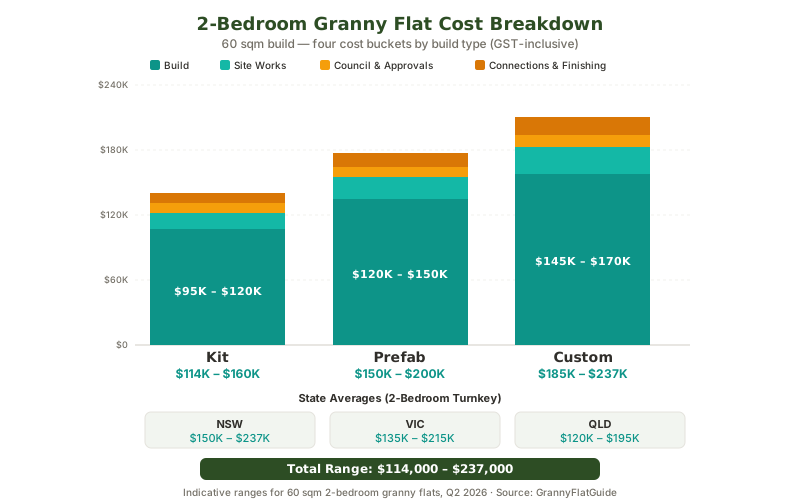
The total project cost for a 2-bedroom granny flat depends heavily on how it’s built. Each build type has a different cost structure, and understanding where the money goes helps you compare quotes accurately.
Kit builds ($114,000 – $160,000 total project) start with a pre-cut materials package costing $35,000 to $55,000. That kit price is not the project price — you still need a slab ($12,000–$18,000), licensed trades for plumbing, electrical, and waterproofing, internal fit-out, and council approvals. Owner-builders can save 20–40% on labour but should budget 500–1,000+ hours of work. If you’re considering this route, our granny flat cost guide breaks down the full four-bucket model in detail.
Prefab and modular builds ($150,000 – $200,000) are factory-built in sections and craned onto a prepared slab. Transport and crane access are the key cost variables — limited street access or overhead power lines can add $3,000 to $8,000. The trade-off is speed: most prefab 2-bedroom builds are completed in 12–16 weeks from slab pour to handover, compared to 16–24 weeks for a site-built custom project.
Custom site-built ($185,000 – $237,000) gives you the most control over layout, materials, and finishes. Premium inclusions — stone benchtops, timber flooring, upgraded tapware, ducted air conditioning — can push a 60sqm custom build past $250,000 in Sydney. But a standard-specification custom build with good-quality fixtures doesn’t have to be the most expensive option; it’s the premium finishes and complex site conditions that drive the upper end.
What’s typically excluded from builder quotes
This is where most cost shocks come from. A builder’s advertised price almost always excludes several line items that are part of your real project cost:
- Site works — slope remediation, retaining walls, rock excavation, tree removal
- Service connections — extending sewer, water, and electrical from the main house or street to the granny flat
- Council and approval fees — CDC or DA lodgement, private certifier, survey, engineering, soil test
- BASIX certificate (NSW) — $50 fee plus the cost of meeting energy and water efficiency requirements
- Utility authority charges — Sydney Water Section 73 compliance certificate, electrical authority connection fees
- Landscaping, driveway, fencing, and pathways between the main house and granny flat
- Temporary facilities — skip bins, portaloo, temporary fencing during construction
When comparing quotes, ask every builder to confirm which of the four cost buckets their price covers. A $145,000 turnkey quote that includes site works and connections is not the same as a $130,000 quote that excludes them — the second quote may end up costing more.
State-by-state pricing differences
NSW — $150,000 to $237,000
NSW has the most established framework for secondary dwellings under the Housing SEPP. The 60sqm internal floor area cap applies to all CDC and DA-approved secondary dwellings. CDC approval (complying development through a private certifier) is faster and typically cheaper than a DA, but requires a minimum 450sqm lot with 12m frontage. A BASIX certificate is mandatory before approval. NSW-specific granny flat rules affect your approval pathway and costs.
Sydney metro builds sit at the upper end of the range due to higher labour costs, stricter site constraints, and Sydney Water compliance requirements. Regional NSW is typically 10–15% lower.
Victoria — $135,000 to $215,000
Victoria removed the planning permit requirement for most granny flats under 60sqm on lots over 300sqm in December 2023. You still need a building permit, and the build must meet the 7-star Whole of Home NatHERS energy rating and Livable Housing Design Standard (Silver Level). The Livable Housing requirement adds $3,000–$8,000 to a standard build — wider doorways, step-free entry, reinforced bathroom walls, and accessible toilet layout.
Victoria also prohibits gas connections to small second dwellings, so all cooking and hot water must be electric — a factor in both build cost and ongoing running costs.
Queensland — $120,000 to $195,000
Queensland costs are generally lower due to lighter site preparation requirements in many areas and less stringent energy efficiency standards compared to NSW and Victoria. However, QLD’s council-driven framework means approval requirements vary significantly. Brisbane City Council allows secondary dwellings up to 80sqm as accepted development. Gold Coast City Council allows up to 80sqm standard, but exceeding that threshold triggers infrastructure charges of approximately $24,000 in sewered areas.
Budgeting: add 10% contingency
At 2-bedroom granny flat project sizes, a 10% contingency means setting aside $14,000 to $24,000 above your expected total. This covers the items that surface during construction — unexpected rock under the slab, longer service runs than quoted, minor design changes, or weather delays.
Industry experience suggests that fewer than half of granny flat builds complete within the original budget. The contingency isn’t a pessimistic addition — it’s realistic project planning.
How to use these figures
These cost ranges are indicative for a standard 2-bedroom granny flat on a flat, accessible site in metro areas, using typical builder specifications. Your specific cost will depend on your block’s slope, access, soil conditions, distance from existing services, and your choice of finishes.
The most reliable way to budget is to get three to five quotes from builders who specialise in granny flats. Choosing the right granny flat builder matters more than finding the cheapest price — a builder who understands your council area, provides a detailed scope of works, and includes site costs in their quote will save you money compared to a low headline price with exclusions. You can compare granny flat builders on our directory to find companies that service your area.
These ranges cover the total project cost for a 60sqm 2-bedroom granny flat, including all four cost buckets: build, site works, council and approvals, and connections. All figures are GST-inclusive and reflect Q2 2026 pricing.
| Scenario | Cost range (AUD, ex GST) | Notes |
|---|---|---|
| Kit build — 2-bed, 60sqm, flat site, metro area | $114,000–$160,000 | Kit materials $35K–$55K plus slab, trades, fit-out, approvals, and connections. Owner-builder labour assumed for lower end. Based on published kit supplier and builder pricing, Q2 2026. |
| Prefab/modular — 2-bed, 60sqm, flat site, metro area | $150,000–$200,000 | Factory-built, transported, and craned onto prepared slab. Includes standard finishes, slab, connections, and approvals. Based on published prefab builder pricing, Q2 2026. |
| Custom site-built — 2-bed, 60sqm, flat site, metro area | $185,000–$237,000 | Designed and built on-site with standard to mid-range finishes. Includes slab, all trades, connections, approvals, and landscaping. Premium finishes can push above $250K. Based on published custom builder pricing, Q2 2026. |
| NSW metro (Sydney) — 2-bed turnkey | $150,000–$237,000 | Includes BASIX compliance, Sydney Water Section 73, and higher metro labour rates. CDC pathway assumed for approval costs. |
| VIC metro (Melbourne) — 2-bed turnkey | $135,000–$215,000 | Includes 7-star NatHERS compliance and Livable Housing Design Standard (Silver Level). No planning permit required for most builds on lots over 300sqm. |
| QLD metro (Brisbane/Gold Coast) — 2-bed turnkey | $120,000–$195,000 | Generally lower site preparation costs. Council approval requirements vary — Brisbane allows 80sqm accepted development. Gold Coast infrastructure charges (~$24K) apply for builds over 80sqm. |
Ranges compiled from published builder pricing pages, supplier quotes, and industry cost guides. All figures GST-inclusive. Site costs assume a flat, accessible block with standard soil conditions. Figures exclude premium upgrades, difficult access, significant slope, or extended service runs. Always obtain multiple quotes for your specific site.
Last checked: Invalid Date
Six factors have the biggest impact on where your 2-bedroom granny flat lands within the $114,000–$237,000 range.
Build type: kit, prefab, or custom
Kit builds cost the least for materials but require either your own labour or a separate builder for assembly. Prefab offers speed and fixed pricing but depends on crane access and transport logistics. Custom builds give maximum design control at the highest cost per square metre — typically $2,400–$3,300/sqm compared to $1,800–$2,200/sqm for kit.
Site conditions and access
A flat block with clear side access (minimum 3m wide for machinery) and standard soil conditions is the baseline for all pricing. Sloping sites requiring cut-and-fill, retaining walls, or stepped foundations can add $15,000–$40,000. Limited access requiring hand-carry of materials adds $5,000–$15,000. Rock excavation is charged per cubic metre and can add $10,000+ on sandstone or shale sites.
Finish level and inclusions
Standard builder specifications — laminate benchtops, vinyl plank flooring, basic tapware, and builder-grade appliances — sit at the lower end. Upgrading to stone benchtops ($3,000–$6,000), timber flooring ($4,000–$8,000), quality tapware and fixtures ($2,000–$5,000), and ducted air conditioning ($6,000–$10,000) can add $15,000–$30,000 to the build cost.
Service connection distance
The distance between the granny flat and existing sewer, water, and electrical connections is a major variable. Short runs (under 10m from the main house) are included in most turnkey quotes. Runs over 15m, or connections requiring a new pit or street connection, can add $8,000–$20,000. Sydney Water compliance alone can cost $2,000–$5,000 in fees.
Approval pathway and state
A CDC in NSW costs $3,000–$7,000 including certifier, surveyor, engineer, and BASIX certificate. A DA adds council lodgement fees and can cost $5,000–$15,000 with longer wait times. Victorian builds save on planning fees (no planning permit required for most) but spend more on NatHERS compliance and Livable Housing requirements. Queensland costs depend entirely on which council you’re in.
Location: metro vs regional
Metro builds (Sydney, Melbourne, Brisbane) cost 10–20% more than regional equivalents due to higher labour rates, stricter site constraints, and higher council fees. Regional builds benefit from lower labour costs but may face longer lead times for materials and trades. In regional areas with limited granny flat builders, fewer competitive quotes can mean higher prices.
Granny flat builders in Australia
Browse profiles, compare service areas, and check reviews.

Garden Studios
★ 5.0 (63 reviews)
View profile →

Perway Ecopods
★ 5.0 (43 reviews)
Perth-based home renovation and construction company offering custom builds with transparent service.
View profile →

Out-Back Portable Buildings
★ 5.0 (25 reviews)
Custom-made, pre-fabricated transportable homes including granny flats, offices, and portable buildings.
View profile →

Adams Cabins
★ 5.0 (20 reviews)
Family-owned cabin builders specializing in log cabins, granny flats, and tiny homes in SE Queensland.
View profile →

ATN Constructions
★ 5.0 (18 reviews)
View profile →

Dare Constructions
★ 5.0 (16 reviews)
Steel frame construction specialist including granny flats, carports, sheds across Newcastle, Hunter Valley, and Sydney.
View profile →
GrannyFlatGuide is a comparison platform. Companies shown are filtered by relevance to this page. Listing does not imply endorsement. GrannyFlatGuide may receive a referral fee when you request quotes.
How we research these costs
Cost ranges on this page are compiled from published builder pricing pages, supplier quote tools, and industry cost guides available as of April 2026. We reviewed pricing from multiple granny flat builders across NSW, Victoria, and Queensland to establish the ranges presented. All figures are GST-inclusive unless otherwise noted.
Primary sources include published turnkey and kit builder pricing, hipages cost guides (residential), and state-specific approval fee schedules from NSW Planning Portal, Victorian Building Authority, and Queensland council websites. Builder-stated pricing is labelled as such and may exclude site costs — we note exclusions where identified.
Last reviewed
Invalid Date
Next review due
Invalid Date
Check your property first
Enter your address to see zoning, overlays, and approval pathway — then connect with local builders when you’re ready.
What can you build on your property?
Enter your address and we'll check your zoning, overlays, and what's possible on your block.
We use your address to check council zoning and planning rules — not stored until you choose to continue.
A turnkey 2-bedroom granny flat in Australia costs between $114,000 and $237,000 GST-inclusive, depending on whether you choose a kit, prefab, or custom build. That range is wide because the base build price is only one part of the total — site works, council approvals, and utility connections add $19,000 to $67,000 on top of the structure itself.
The 2-bedroom layout is the most commonly built granny flat size in Australia. At 50–60 square metres, it fits within the 60sqm cap in NSW and Victoria while providing enough space for a separate living area, kitchen, bathroom, and two bedrooms. For families accommodating elderly parents, this is the configuration that balances independence with proximity. For investors, two bedrooms command higher weekly rent and attract a wider tenant pool.
This page breaks down the four cost buckets that make up your total project price, compares kit, prefab, and custom build types, and shows how costs differ across NSW, Victoria, and Queensland. Every figure includes a methodology note and a date — because a cost page that doesn’t tell you when its data was last checked isn’t worth reading.
Kit, prefab, or custom — what you’ll actually pay
The total project cost for a 2-bedroom granny flat depends heavily on how it’s built. Each build type has a different cost structure, and understanding where the money goes helps you compare quotes accurately.
Kit builds ($114,000 – $160,000 total project) start with a pre-cut materials package costing $35,000 to $55,000. That kit price is not the project price — you still need a slab ($12,000–$18,000), licensed trades for plumbing, electrical, and waterproofing, internal fit-out, and council approvals. Owner-builders can save 20–40% on labour but should budget 500–1,000+ hours of work. If you’re considering this route, our granny flat cost guide breaks down the full four-bucket model in detail.
Prefab and modular builds ($150,000 – $200,000) are factory-built in sections and craned onto a prepared slab. Transport and crane access are the key cost variables — limited street access or overhead power lines can add $3,000 to $8,000. The trade-off is speed: most prefab 2-bedroom builds are completed in 12–16 weeks from slab pour to handover, compared to 16–24 weeks for a site-built custom project.
Custom site-built ($185,000 – $237,000) gives you the most control over layout, materials, and finishes. Premium inclusions — stone benchtops, timber flooring, upgraded tapware, ducted air conditioning — can push a 60sqm custom build past $250,000 in Sydney. But a standard-specification custom build with good-quality fixtures doesn’t have to be the most expensive option; it’s the premium finishes and complex site conditions that drive the upper end.
What’s typically excluded from builder quotes
This is where most cost shocks come from. A builder’s advertised price almost always excludes several line items that are part of your real project cost:
- Site works — slope remediation, retaining walls, rock excavation, tree removal
- Service connections — extending sewer, water, and electrical from the main house or street to the granny flat
- Council and approval fees — CDC or DA lodgement, private certifier, survey, engineering, soil test
- BASIX certificate (NSW) — $50 fee plus the cost of meeting energy and water efficiency requirements
- Utility authority charges — Sydney Water Section 73 compliance certificate, electrical authority connection fees
- Landscaping, driveway, fencing, and pathways between the main house and granny flat
- Temporary facilities — skip bins, portaloo, temporary fencing during construction
When comparing quotes, ask every builder to confirm which of the four cost buckets their price covers. A $145,000 turnkey quote that includes site works and connections is not the same as a $130,000 quote that excludes them — the second quote may end up costing more.
State-by-state pricing differences
NSW — $150,000 to $237,000
NSW has the most established framework for secondary dwellings under the Housing SEPP. The 60sqm internal floor area cap applies to all CDC and DA-approved secondary dwellings. CDC approval (complying development through a private certifier) is faster and typically cheaper than a DA, but requires a minimum 450sqm lot with 12m frontage. A BASIX certificate is mandatory before approval. NSW-specific granny flat rules affect your approval pathway and costs.
Sydney metro builds sit at the upper end of the range due to higher labour costs, stricter site constraints, and Sydney Water compliance requirements. Regional NSW is typically 10–15% lower.
Victoria — $135,000 to $215,000
Victoria removed the planning permit requirement for most granny flats under 60sqm on lots over 300sqm in December 2023. You still need a building permit, and the build must meet the 7-star Whole of Home NatHERS energy rating and Livable Housing Design Standard (Silver Level). The Livable Housing requirement adds $3,000–$8,000 to a standard build — wider doorways, step-free entry, reinforced bathroom walls, and accessible toilet layout.
Victoria also prohibits gas connections to small second dwellings, so all cooking and hot water must be electric — a factor in both build cost and ongoing running costs.
Queensland — $120,000 to $195,000
Queensland costs are generally lower due to lighter site preparation requirements in many areas and less stringent energy efficiency standards compared to NSW and Victoria. However, QLD’s council-driven framework means approval requirements vary significantly. Brisbane City Council allows secondary dwellings up to 80sqm as accepted development. Gold Coast City Council allows up to 80sqm standard, but exceeding that threshold triggers infrastructure charges of approximately $24,000 in sewered areas.
Budgeting: add 10% contingency
At 2-bedroom granny flat project sizes, a 10% contingency means setting aside $14,000 to $24,000 above your expected total. This covers the items that surface during construction — unexpected rock under the slab, longer service runs than quoted, minor design changes, or weather delays.
Industry experience suggests that fewer than half of granny flat builds complete within the original budget. The contingency isn’t a pessimistic addition — it’s realistic project planning.
How to use these figures
These cost ranges are indicative for a standard 2-bedroom granny flat on a flat, accessible site in metro areas, using typical builder specifications. Your specific cost will depend on your block’s slope, access, soil conditions, distance from existing services, and your choice of finishes.
The most reliable way to budget is to get three to five quotes from builders who specialise in granny flats. Choosing the right granny flat builder matters more than finding the cheapest price — a builder who understands your council area, provides a detailed scope of works, and includes site costs in their quote will save you money compared to a low headline price with exclusions. You can compare granny flat builders on our directory to find companies that service your area.
These ranges cover the total project cost for a 60sqm 2-bedroom granny flat, including all four cost buckets: build, site works, council and approvals, and connections. All figures are GST-inclusive and reflect Q2 2026 pricing.
| Scenario | Cost range (AUD, ex GST) | Notes |
|---|---|---|
| Kit build — 2-bed, 60sqm, flat site, metro area | $114,000–$160,000 | Kit materials $35K–$55K plus slab, trades, fit-out, approvals, and connections. Owner-builder labour assumed for lower end. Based on published kit supplier and builder pricing, Q2 2026. |
| Prefab/modular — 2-bed, 60sqm, flat site, metro area | $150,000–$200,000 | Factory-built, transported, and craned onto prepared slab. Includes standard finishes, slab, connections, and approvals. Based on published prefab builder pricing, Q2 2026. |
| Custom site-built — 2-bed, 60sqm, flat site, metro area | $185,000–$237,000 | Designed and built on-site with standard to mid-range finishes. Includes slab, all trades, connections, approvals, and landscaping. Premium finishes can push above $250K. Based on published custom builder pricing, Q2 2026. |
| NSW metro (Sydney) — 2-bed turnkey | $150,000–$237,000 | Includes BASIX compliance, Sydney Water Section 73, and higher metro labour rates. CDC pathway assumed for approval costs. |
| VIC metro (Melbourne) — 2-bed turnkey | $135,000–$215,000 | Includes 7-star NatHERS compliance and Livable Housing Design Standard (Silver Level). No planning permit required for most builds on lots over 300sqm. |
| QLD metro (Brisbane/Gold Coast) — 2-bed turnkey | $120,000–$195,000 | Generally lower site preparation costs. Council approval requirements vary — Brisbane allows 80sqm accepted development. Gold Coast infrastructure charges (~$24K) apply for builds over 80sqm. |
Ranges compiled from published builder pricing pages, supplier quotes, and industry cost guides. All figures GST-inclusive. Site costs assume a flat, accessible block with standard soil conditions. Figures exclude premium upgrades, difficult access, significant slope, or extended service runs. Always obtain multiple quotes for your specific site.
Last checked: Invalid Date
Six factors have the biggest impact on where your 2-bedroom granny flat lands within the $114,000–$237,000 range.
Build type: kit, prefab, or custom
Kit builds cost the least for materials but require either your own labour or a separate builder for assembly. Prefab offers speed and fixed pricing but depends on crane access and transport logistics. Custom builds give maximum design control at the highest cost per square metre — typically $2,400–$3,300/sqm compared to $1,800–$2,200/sqm for kit.
Site conditions and access
A flat block with clear side access (minimum 3m wide for machinery) and standard soil conditions is the baseline for all pricing. Sloping sites requiring cut-and-fill, retaining walls, or stepped foundations can add $15,000–$40,000. Limited access requiring hand-carry of materials adds $5,000–$15,000. Rock excavation is charged per cubic metre and can add $10,000+ on sandstone or shale sites.
Finish level and inclusions
Standard builder specifications — laminate benchtops, vinyl plank flooring, basic tapware, and builder-grade appliances — sit at the lower end. Upgrading to stone benchtops ($3,000–$6,000), timber flooring ($4,000–$8,000), quality tapware and fixtures ($2,000–$5,000), and ducted air conditioning ($6,000–$10,000) can add $15,000–$30,000 to the build cost.
Service connection distance
The distance between the granny flat and existing sewer, water, and electrical connections is a major variable. Short runs (under 10m from the main house) are included in most turnkey quotes. Runs over 15m, or connections requiring a new pit or street connection, can add $8,000–$20,000. Sydney Water compliance alone can cost $2,000–$5,000 in fees.
Approval pathway and state
A CDC in NSW costs $3,000–$7,000 including certifier, surveyor, engineer, and BASIX certificate. A DA adds council lodgement fees and can cost $5,000–$15,000 with longer wait times. Victorian builds save on planning fees (no planning permit required for most) but spend more on NatHERS compliance and Livable Housing requirements. Queensland costs depend entirely on which council you’re in.
Location: metro vs regional
Metro builds (Sydney, Melbourne, Brisbane) cost 10–20% more than regional equivalents due to higher labour rates, stricter site constraints, and higher council fees. Regional builds benefit from lower labour costs but may face longer lead times for materials and trades. In regional areas with limited granny flat builders, fewer competitive quotes can mean higher prices.
Granny flat builders in Australia
Browse profiles, compare service areas, and check reviews.
Garden Studios
★ 5.0 (63 reviews)
View profile →
Perway Ecopods
★ 5.0 (43 reviews)
Perth-based home renovation and construction company offering custom builds with transparent service.
View profile →
Out-Back Portable Buildings
★ 5.0 (25 reviews)
Custom-made, pre-fabricated transportable homes including granny flats, offices, and portable buildings.
View profile →
Adams Cabins
★ 5.0 (20 reviews)
Family-owned cabin builders specializing in log cabins, granny flats, and tiny homes in SE Queensland.
View profile →
ATN Constructions
★ 5.0 (18 reviews)
View profile →
Dare Constructions
★ 5.0 (16 reviews)
Steel frame construction specialist including granny flats, carports, sheds across Newcastle, Hunter Valley, and Sydney.
View profile →
GrannyFlatGuide is a comparison platform. Companies shown are filtered by relevance to this page. Listing does not imply endorsement. GrannyFlatGuide may receive a referral fee when you request quotes.
How we research these costs
Cost ranges on this page are compiled from published builder pricing pages, supplier quote tools, and industry cost guides available as of April 2026. We reviewed pricing from multiple granny flat builders across NSW, Victoria, and Queensland to establish the ranges presented. All figures are GST-inclusive unless otherwise noted.
Primary sources include published turnkey and kit builder pricing, hipages cost guides (residential), and state-specific approval fee schedules from NSW Planning Portal, Victorian Building Authority, and Queensland council websites. Builder-stated pricing is labelled as such and may exclude site costs — we note exclusions where identified.
Last reviewed
Invalid Date
Next review due
Invalid Date
Check your property first
Enter your address to see zoning, overlays, and approval pathway — then connect with local builders when you’re ready.
What can you build on your property?
Enter your address and we'll check your zoning, overlays, and what's possible on your block.
We use your address to check council zoning and planning rules — not stored until you choose to continue.
Frequently asked questions
A 2-bedroom granny flat in NSW typically costs $150,000 to $237,000 GST-inclusive for a turnkey build on a flat, accessible site. This includes the build itself, site works, CDC or DA approval, BASIX certificate, and service connections. Sydney metro builds sit at the upper end due to higher labour costs and Sydney Water compliance requirements. Regional NSW is typically 10–15% lower.
A kit build with owner-builder labour is the cheapest option, with total project costs starting around $114,000 GST-inclusive for a 60sqm 2-bedroom layout. The kit materials package costs $35,000–$55,000, but you still need a slab, licensed trades for plumbing, electrical, and waterproofing, council approvals, and service connections. Realistic savings from owner-building are 20–40% compared to a turnkey build, but require 500–1,000+ hours of work.
Most 2-bedroom granny flats are 50–60 square metres of internal floor area. In NSW and Victoria, the maximum for a secondary dwelling is 60sqm. This provides enough space for two bedrooms, a combined living and kitchen area, a bathroom, and a small laundry. Some Queensland councils allow secondary dwellings up to 80sqm, giving more flexibility in the layout.
Industry research (including the CoreLogic/Archistar report) suggests a granny flat can add up to 30% to a property’s value, though this is a potential figure and not guaranteed. A compliant 2-bedroom granny flat with proper approvals and an Occupation Certificate adds more value than a studio because it attracts a wider tenant pool and commands higher rent. Bank valuations are conservative and don’t attribute dollar-for-dollar value for the build cost.
Timelines vary by build type. Prefab and modular builds typically take 12–16 weeks from slab pour to handover. Custom site-built projects take 16–24 weeks. Kit builds with an owner-builder can take 6–12 months depending on available time. Add 2–6 weeks for the approval process (CDC) or 8–26+ weeks for a DA. Total project timeline from first quote to move-in is typically 4–9 months.
A turnkey price typically covers design, council approvals, slab, full structural build, internal fit-out (kitchen, bathroom, flooring, painting), plumbing, electrical, and handover. However, ‘turnkey’ often excludes site works (retaining walls, tree removal, slope remediation), extended service connections, utility authority fees, landscaping, driveways, and fencing. Always ask your builder to confirm exactly what’s included and excluded in writing.
Queensland 2-bedroom granny flat costs are generally 10–20% lower than NSW, with a typical range of $120,000–$195,000. This reflects lower site preparation costs in many areas and less stringent energy efficiency requirements. However, costs vary significantly by council. Gold Coast City Council charges approximately $24,000 in infrastructure charges for secondary dwellings over 80sqm in sewered areas, which can offset the general cost advantage.
Yes, all granny flats require some form of approval. In NSW, you can use the CDC pathway (fast-track through a private certifier, 10–20 business days) if your property meets Housing SEPP criteria — minimum 450sqm lot, 12m frontage, and no overlay exclusions. Otherwise, you need a DA (6–12+ weeks). In Victoria, no planning permit is needed for most builds under 60sqm on lots over 300sqm, but a building permit is always required. Queensland uses council-specific accepted development criteria.
Rental income varies by location and market conditions. In metro Sydney, a well-finished 2-bedroom granny flat can achieve $400–$550 per week. Melbourne yields are typically $350–$480, and Brisbane $320–$420. Two-bedroom layouts command 25–40% higher weekly rent than studio or 1-bedroom configurations. At $450/week and a $180,000 build cost, the gross rental yield before expenses is approximately 13% — though holding costs, insurance, maintenance, and vacancy reduce the net figure.
A 2-bedroom granny flat costs $20,000–$50,000 more than a 1-bedroom but commands significantly higher rent and attracts a wider tenant pool. For rental investment, the 2-bedroom is almost always the better return per dollar spent. For family accommodation — elderly parents or adult children — two bedrooms provide a spare room for visitors or a home office. The main reason to build 1-bedroom is a smaller lot where 60sqm won’t fit within setback requirements, or a tight budget.
The most common ‘hidden’ costs are actually known line items that builders exclude from their quoted price: site works ($10,000–$30,000 for earthworks, retaining walls, tree removal), service connections ($6,000–$22,000 for sewer, water, electrical), council and approval fees ($3,000–$15,000), utility authority charges (Sydney Water Section 73, electrical authority fees), temporary facilities during construction, and landscaping. Budget a 10% contingency ($14,000–$24,000) on top of your total estimate.
Related guides
Category
2 Bedroom Granny Flat — Layouts, Costs and Design Ideas for Australia
2-bedroom granny flats from $130,000 to $280,000 — popular layouts, realistic costs and design ideas. The most common build type in Australia.
Guide
Granny Flat Rules Victoria 2026 — Planning & Building Guide
Victoria's granny flat rules explained — planning permits, 60sqm cap, building requirements, DPU changes, and how the 2023-2026 reforms affect your build.
Guide
Granny Flat Rules NSW — CDC, Setbacks & Approvals (2026)
NSW granny flat rules explained — lot size minimums, CDC vs DA pathways, setback distances and BASIX requirements under SEPP (Housing) 2021.
Cost guide
Granny Flat Prices in Australia — Real Builder Pricing Compared (2026)
Compare real granny flat prices across budget prefab, mid-range custom, and premium turnkey tiers. See what the 'from' price includes and what you'll actually pay in 2026.
Ready to compare 2-bedroom granny flat quotes?
Your actual cost depends on your block, your council, and your choice of build type. Get free, no-obligation quotes from granny flat builders in your area to see what your specific project will cost.
Join 1,000+ Australians who've used GrannyFlatGuide to research their granny flat project
Get free quotes