Design + Approval
From site assessment to council-approved plans — what the design and approval process involves and what it costs.
Design and approval covers everything from the initial site assessment through to council-approved construction plans. As of Q1 2026, the combined cost ranges from $5,000 to $25,000 depending on your approval pathway, site complexity and whether you use an independent designer or a builder's in-house service.
This stage produces the architectural plans, engineering documentation and council approval you need before any construction can begin. Without approved plans, no builder can legally start work and no certifier can issue an occupation certificate.
You can commission design and approval independently from a building designer or architect, or you can bundle it with your builder as part of a turnkey package. Separating design from construction lets you get competitive fixed-price build quotes from multiple builders using the same approved plans.
Granny flat builders in Australia
Browse profiles, compare service areas, and check reviews.
Garden Studios
★ 5.0 (63 reviews)
View profile →

Perway Ecopods
★ 5.0 (43 reviews)
Perth-based home renovation and construction company offering custom builds with transparent service.
View profile →
Out-Back Portable Buildings
★ 5.0 (25 reviews)
Custom-made, pre-fabricated transportable homes including granny flats, offices, and portable buildings.
View profile →
Adams Cabins
★ 5.0 (20 reviews)
Family-owned cabin builders specializing in log cabins, granny flats, and tiny homes in SE Queensland.
View profile →
ATN Constructions
★ 5.0 (18 reviews)
View profile →
Dare Constructions
★ 5.0 (16 reviews)
Steel frame construction specialist including granny flats, carports, sheds across Newcastle, Hunter Valley, and Sydney.
View profile →
GrannyFlatGuide is a comparison platform. Companies shown are filtered by relevance to this page. Listing does not imply endorsement. GrannyFlatGuide may receive a referral fee when you request quotes.
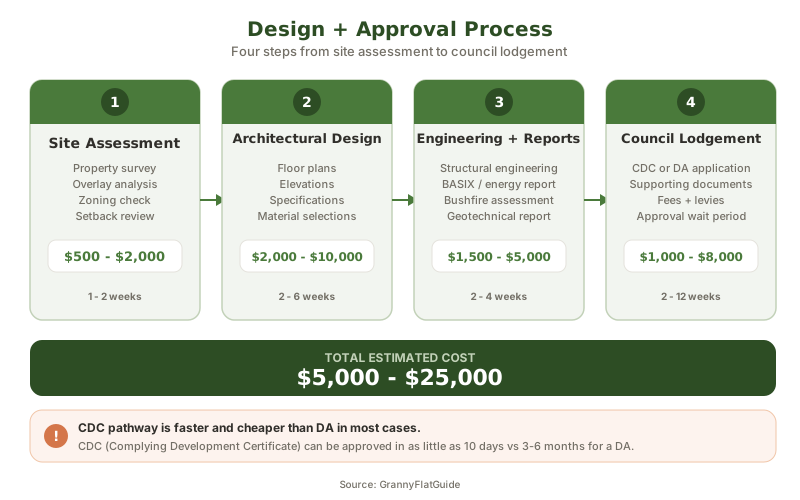
The four stages of design and approval
1. Site assessment
A designer or town planner visits your property to assess constraints — lot size, setbacks, zoning, overlays (flood, heritage, bushfire), existing structures, tree canopy and service locations. They review the site survey (or commission one if you do not have a recent survey). This stage costs $500 to $2,000 and takes 1 to 2 weeks.
2. Architectural design
The designer produces floor plans, elevations, sections and specifications based on your brief. You will typically see a concept design, then a developed design for feedback, then construction documentation. Fees range from $2,000 to $10,000 depending on complexity and whether you are using standard modified plans or a fully custom design.
3. Engineering and reports
Structural engineering drawings ($1,500 to $3,000), BASIX certificate or energy report ($500 to $1,500 depending on state), and any specialist reports your site requires — bushfire assessment, flood study, geotechnical report, or heritage impact statement. Total: $1,500 to $5,000.
4. Council lodgement
Your plans are lodged for either a Complying Development Certificate (CDC) through a private certifier, or a Development Application (DA) through your local council. CDC costs $1,000 to $3,000 and takes 10 to 20 business days. DA costs $3,000 to $8,000 in fees and takes 6 to 12 weeks.
CDC vs DA — which pathway?
CDC is faster and cheaper but only available when your design meets all the prescriptive standards — setbacks, height limits, floor area, and no site constraints (flood, heritage, bushfire above BAL 12.5). If your design does not comply on any single point, you need a DA.
DA gives council discretion to approve designs that do not meet every prescriptive standard, but it takes longer, costs more, and requires neighbour notification. About 60 to 70 percent of granny flat builds in NSW use the CDC pathway.
Independent designer vs builder in-house
Using your builder's in-house design service is convenient and often cheaper upfront — some builders absorb the design cost into the build contract. The trade-off is that you are committed to that builder before seeing competitive quotes.
Commissioning independent plans costs more initially but gives you approved construction drawings that any licensed builder can quote on. This typically saves 10 to 20 percent on the build cost through competitive tendering.
Design and approval cost breakdown
These costs cover the design and approval phase only — before construction begins. Figures are indicative as of Q1 2026.
| Scenario | Cost range (AUD, ex GST) | Notes |
|---|---|---|
| Site assessment and survey | $500–$2,000 | Site visit, constraint analysis, and survey review or commissioning. Some designers include this in their design fee. |
| Architectural design | $2,000–$10,000 | Floor plans, elevations, construction documentation. Standard modified plans at the low end, fully custom at the high end. |
| Engineering and reports | $1,500–$5,000 | Structural engineering, BASIX/energy, plus any specialist reports (bushfire, flood, geotechnical, heritage). |
| Council lodgement — CDC | $1,000–$3,000 | Private certifier fees for Complying Development Certificate. Fastest approval pathway (10–20 business days). |
| Council lodgement — DA | $3,000–$8,000 | Council application fees for Development Application. Required when CDC criteria are not met (6–12 weeks). |
Ranges compiled from published fees from building designers, architects, private certifiers and councils across NSW, VIC and QLD.
Last checked: 1 April 2026
See if your property qualifies
Your property’s zoning and overlays determine what you can build. Check yours for free.
What can you build on your property?
Enter your address and we'll check your zoning, overlays, and what's possible on your block.
We use your address to check council zoning and planning rules — not stored until you choose to continue.
Design and approval covers everything from the initial site assessment through to council-approved construction plans. As of Q1 2026, the combined cost ranges from $5,000 to $25,000 depending on your approval pathway, site complexity and whether you use an independent designer or a builder's in-house service.
This stage produces the architectural plans, engineering documentation and council approval you need before any construction can begin. Without approved plans, no builder can legally start work and no certifier can issue an occupation certificate.
You can commission design and approval independently from a building designer or architect, or you can bundle it with your builder as part of a turnkey package. Separating design from construction lets you get competitive fixed-price build quotes from multiple builders using the same approved plans.
Granny flat builders in Australia
Browse profiles, compare service areas, and check reviews.
Garden Studios
★ 5.0 (63 reviews)
View profile →
Perway Ecopods
★ 5.0 (43 reviews)
Perth-based home renovation and construction company offering custom builds with transparent service.
View profile →
Out-Back Portable Buildings
★ 5.0 (25 reviews)
Custom-made, pre-fabricated transportable homes including granny flats, offices, and portable buildings.
View profile →
Adams Cabins
★ 5.0 (20 reviews)
Family-owned cabin builders specializing in log cabins, granny flats, and tiny homes in SE Queensland.
View profile →
ATN Constructions
★ 5.0 (18 reviews)
View profile →
Dare Constructions
★ 5.0 (16 reviews)
Steel frame construction specialist including granny flats, carports, sheds across Newcastle, Hunter Valley, and Sydney.
View profile →
GrannyFlatGuide is a comparison platform. Companies shown are filtered by relevance to this page. Listing does not imply endorsement. GrannyFlatGuide may receive a referral fee when you request quotes.
The four stages of design and approval
1. Site assessment
A designer or town planner visits your property to assess constraints — lot size, setbacks, zoning, overlays (flood, heritage, bushfire), existing structures, tree canopy and service locations. They review the site survey (or commission one if you do not have a recent survey). This stage costs $500 to $2,000 and takes 1 to 2 weeks.
2. Architectural design
The designer produces floor plans, elevations, sections and specifications based on your brief. You will typically see a concept design, then a developed design for feedback, then construction documentation. Fees range from $2,000 to $10,000 depending on complexity and whether you are using standard modified plans or a fully custom design.
3. Engineering and reports
Structural engineering drawings ($1,500 to $3,000), BASIX certificate or energy report ($500 to $1,500 depending on state), and any specialist reports your site requires — bushfire assessment, flood study, geotechnical report, or heritage impact statement. Total: $1,500 to $5,000.
4. Council lodgement
Your plans are lodged for either a Complying Development Certificate (CDC) through a private certifier, or a Development Application (DA) through your local council. CDC costs $1,000 to $3,000 and takes 10 to 20 business days. DA costs $3,000 to $8,000 in fees and takes 6 to 12 weeks.
CDC vs DA — which pathway?
CDC is faster and cheaper but only available when your design meets all the prescriptive standards — setbacks, height limits, floor area, and no site constraints (flood, heritage, bushfire above BAL 12.5). If your design does not comply on any single point, you need a DA.
DA gives council discretion to approve designs that do not meet every prescriptive standard, but it takes longer, costs more, and requires neighbour notification. About 60 to 70 percent of granny flat builds in NSW use the CDC pathway.
Independent designer vs builder in-house
Using your builder's in-house design service is convenient and often cheaper upfront — some builders absorb the design cost into the build contract. The trade-off is that you are committed to that builder before seeing competitive quotes.
Commissioning independent plans costs more initially but gives you approved construction drawings that any licensed builder can quote on. This typically saves 10 to 20 percent on the build cost through competitive tendering.
Design and approval cost breakdown
These costs cover the design and approval phase only — before construction begins. Figures are indicative as of Q1 2026.
| Scenario | Cost range (AUD, ex GST) | Notes |
|---|---|---|
| Site assessment and survey | $500–$2,000 | Site visit, constraint analysis, and survey review or commissioning. Some designers include this in their design fee. |
| Architectural design | $2,000–$10,000 | Floor plans, elevations, construction documentation. Standard modified plans at the low end, fully custom at the high end. |
| Engineering and reports | $1,500–$5,000 | Structural engineering, BASIX/energy, plus any specialist reports (bushfire, flood, geotechnical, heritage). |
| Council lodgement — CDC | $1,000–$3,000 | Private certifier fees for Complying Development Certificate. Fastest approval pathway (10–20 business days). |
| Council lodgement — DA | $3,000–$8,000 | Council application fees for Development Application. Required when CDC criteria are not met (6–12 weeks). |
Ranges compiled from published fees from building designers, architects, private certifiers and councils across NSW, VIC and QLD.
Last checked: 1 April 2026
See if your property qualifies
Your property’s zoning and overlays determine what you can build. Check yours for free.
What can you build on your property?
Enter your address and we'll check your zoning, overlays, and what's possible on your block.
We use your address to check council zoning and planning rules — not stored until you choose to continue.
Design and approval at a glance
Total cost range
$5,000 to $25,000 from site assessment through to approved plans. CDC pathway is typically cheaper than DA.
Timeline
4 to 16 weeks. CDC applications take 10 to 20 business days once lodged. DA applications take 6 to 12 weeks or longer.
Key deliverables
Architectural plans, structural engineering, BASIX or energy report (state-dependent), and a CDC or DA approval certificate.
Who provides this
Building designers, architects, specialist granny flat companies with in-house design teams, or town planners who coordinate the full package.
Related guides
Guide
Granny Flat Rules Victoria 2026 — Planning & Building Guide
Victoria's granny flat rules explained — planning permits, 60sqm cap, building requirements, DPU changes, and how the 2023-2026 reforms affect your build.
Guide
Granny Flat Rules NSW — CDC, Setbacks & Approvals (2026)
NSW granny flat rules explained — lot size minimums, CDC vs DA pathways, setback distances and BASIX requirements under SEPP (Housing) 2021.
Cost guide
2 Bedroom Granny Flat Cost — Pricing by Build Type (2026)
A 2-bedroom granny flat costs $114,000–$237,000 GST-inclusive in Australia. See pricing by build type (kit, prefab, custom), state, and finish level.
Cost guide
Granny Flat Prices in Australia — Real Builder Pricing Compared (2026)
Compare real granny flat prices across budget prefab, mid-range custom, and premium turnkey tiers. See what the 'from' price includes and what you'll actually pay in 2026.
Get design and approval quotes
Connect with building designers and town planners experienced with granny flat approvals in your area. Free, no obligation.
Join 1,000+ Australians who've used GrannyFlatGuide to research their granny flat project
Get free quotes