Granny Flat Prices in Australia
Compare real builder pricing across budget prefab, mid-range custom, and premium turnkey tiers — and see what the advertised 'from' price actually includes.
Every granny flat builder in Australia advertises a 'from' price. It appears on their homepage, in their brochures, and in their ads — and it is almost never the final number you will pay. The gap between advertised pricing and your actual all-in cost typically ranges from $20,000 to $70,000, depending on your builder tier and site conditions.
This guide breaks down real granny flat prices across three distinct builder tiers as of Q2 2026. Rather than quoting a single range, we show you what each tier's 'from' price actually includes, what it excludes, and what you should budget for the complete project.
Whether you are exploring a budget prefab kit at $80,000 or a premium turnkey build at $250,000, understanding the gap between the advertised price and the all-in cost is the most important step before requesting quotes.
Understanding 'from' prices in the granny flat market
Every granny flat builder in Australia publishes a 'from' price. It is the number on their homepage, in their brochures, and in their ads — and it is almost never the number you will actually pay.
The gap between a builder's advertised 'from' price and your final all-in cost is one of the most common sources of frustration for homeowners planning a granny flat build. Industry research suggests this gap typically ranges from $20,000 to $70,000 depending on the builder tier and your site conditions. Understanding why that gap exists — and what drives it — is the single most useful thing you can learn before requesting quotes.
This page breaks down real granny flat prices across three distinct builder tiers as of Q2 2026, explains exactly what is and is not included at each price point, and gives you a framework for comparing quotes on a like-for-like basis. For a detailed breakdown of the four main cost buckets (build, site works, council fees, and connections), see our comprehensive granny flat building costs guide.
Three pricing tiers: what you will actually pay
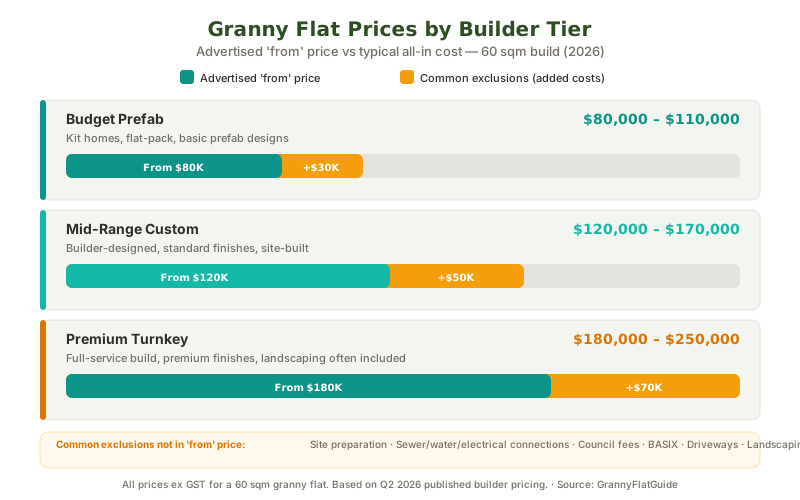
Budget prefab: $80,000 – $110,000 all-in
Budget prefab granny flats are typically kit homes, flat-pack designs, or basic factory-built units. The advertised 'from' price for these options generally starts around $80,000 ex GST for a 60 sqm two-bedroom design.
At this price point, the 'from' price usually covers the building structure itself — framing, cladding, roofing, internal lining, basic kitchen, bathroom, and flooring. What it does not cover is often substantial: site preparation (including excavation, levelling, and retaining walls if your block slopes), the concrete slab, sewer and water connections, electrical connection to the main switchboard, council or certifier fees, and landscaping.
For a budget prefab build, expect to add $20,000 to $30,000 on top of the advertised price for a straightforward site. If your block has a slope greater than 300mm, difficult access, long service runs, or trees requiring removal, site costs can push the total well beyond $110,000.
Budget prefab suits owner-builders with construction experience, buyers on flat blocks with easy access, and anyone building a studio granny flat for short-term rental income where basic finishes are acceptable.
Mid-range custom: $120,000 – $170,000 all-in
The mid-range tier is where most Australian granny flat builders operate. These are site-built designs — either from the builder's standard range or with minor customisations — with standard finishes and a more comprehensive inclusions list.
At a 'from' price of around $120,000, mid-range builders typically include the slab, full build, standard kitchen with stone benchtops, tiled bathroom, internal painting, and basic external cladding. Some include the CDC or DA application in their package. However, site works, utility connections, driveways, fencing, and landscaping are usually excluded.
The exclusion gap at this tier is typically $30,000 to $50,000. A significant portion of this goes to sewer and water connections ($3,000–$8,000), electrical connection ($2,000–$5,000), and site preparation ($5,000–$25,000 depending on conditions). Council-related fees — including your CDC or DA application, certifier inspections, surveyor, engineer, and BASIX certificate in NSW — typically add $5,000 to $12,000.
Mid-range custom is the most popular tier for families building a granny flat for ageing parents or as a long-term rental. The standard of finish is good enough to attract quality tenants, and the inclusions list is broad enough that surprises are fewer than at the budget tier.
Premium turnkey: $180,000 – $250,000 all-in
Premium turnkey builders offer a genuinely all-inclusive service. Their 'from' price — typically starting around $180,000 for a 60 sqm build — covers design, approvals, the full build, and most or all of the items that other tiers exclude.
At this price point, you can expect premium finishes (engineered timber flooring, stone benchtops, soft-close cabinetry), higher-quality cladding options (brick veneer, custom Colorbond), and a more architecturally considered design. Most premium turnkey packages include the approval process, site works allowance, standard utility connections, driveway, and basic landscaping.
Even at the turnkey tier, exclusions can exist. Retaining walls over a certain height, long sewer runs (over 15–20 metres from the main), gas connections, air conditioning, window furnishings, and external storage are commonly excluded. On a complex site, premium turnkey builds can exceed $250,000.
This tier suits homeowners who want minimal project management involvement, those building to maximise rental appeal or property value, and anyone on a site with constraints that budget builders may struggle to accommodate.
What drives the gap between 'from' and all-in pricing?
Five factors consistently account for the price gap across all tiers:
1. Site preparation and earthworks
Site costs are the single largest variable in any granny flat project. A flat block with good access might cost $3,000–$5,000 to prepare. A sloping block requiring cut-and-fill, retaining walls, and rock excavation can cost $15,000–$40,000 or more. Most builders exclude site works from their 'from' price because costs are impossible to estimate without a site inspection.
2. Utility connections
Connecting your granny flat to sewer, water, electricity, and (optionally) gas involves both a licensed tradesperson and, in many cases, utility authority fees. Sydney Water charges a Section 73 compliance certificate fee, and connection costs increase with distance from the main dwelling. Budget $8,000–$15,000 for all connections on a standard site.
3. Council and approval fees
In NSW, a CDC (Complying Development Certificate) through a private certifier costs $3,000–$6,000. A DA (Development Application) through council costs $1,500–$5,000 in application fees plus $3,000–$8,000 for required reports (surveyor, engineer, bushfire, contamination if applicable). Add the BASIX certificate ($50) and ongoing certifier inspection fees ($2,000–$4,000). Other states have comparable costs under different names.
4. Driveways, paths, and landscaping
Most builders quote on the granny flat structure only. Access driveways, concrete paths, fencing between the main dwelling and granny flat, and landscape reinstatement after construction are almost always excluded. Budget $3,000–$10,000 depending on site layout and council requirements.
5. Upgrades and contract variations
Variations to the original contract — whether from unexpected site conditions or finish upgrades — can add 5–15% to the contract price. Before signing, understand the builder's variation process and get written quotes for any changes. A well-specified contract with fewer allowances reduces the risk of costly variations.
How granny flat prices vary by state
Granny flat prices are not uniform across Australia. Several state-specific factors influence the final cost:
NSW remains the largest granny flat market. The 60 sqm floor area cap under the Housing SEPP keeps builds compact, and the CDC pathway means faster approvals (10–20 business days). However, Sydney's higher labour costs and Sydney Water connection fees push all-in prices toward the upper end of each tier.
Victoria has seen growing demand since planning reforms simplified the small second dwelling pathway. Builds must meet a 7-star NatHERS energy rating and Livable Housing Design Standard (Silver Level), which adds $5,000–$10,000 to construction costs compared with a standard NSW build.
Queensland offers more flexibility on floor area — some councils allow secondary dwellings up to 80 sqm or larger — but infrastructure charges in areas like the Gold Coast can add up to $24,000 for builds over 80 sqm. Approval pathways vary significantly between councils.
Western Australia operates under R-Codes, with ancillary dwelling provisions that differ by residential density code (R20, R25, R30+). Perth's lower labour costs generally place builds at the lower end of each pricing tier.
Getting accurate pricing for your project
The only reliable way to know what your granny flat will cost is to get multiple detailed quotes from builders who have inspected your site. When comparing quotes, choosing the right granny flat builder matters — look for itemised pricing that separates the base build from site works, connections, and approval costs.
Request at least three quotes, and for each one, check whether the quote includes or excludes: the slab or foundation, site preparation, all utility connections, council and approval fees, driveways and paths, landscaping, and GST. A builder who quotes $120,000 with all of these included is offering better value than one quoting $100,000 with $40,000 of exclusions.
For a detailed look at what each cost bucket covers, see our granny flat building costs breakdown. If you are comparing specific build types, our guides to granny flat designs and studio granny flats include pricing context for each configuration.
Granny flat price ranges by build type
These price ranges reflect published builder pricing and verified quote data for a standard 60 sqm granny flat as of Q2 2026. All figures are ex GST. Your actual cost will depend on site conditions, location, finish level, and approval pathway.
| Scenario | Cost range (AUD, ex GST) | Notes |
|---|---|---|
| Budget prefab (kit/flat-pack) | $80,000–$110,000 | Based on published pricing from kit home and prefab suppliers. 'From' price typically covers structure only — site works, slab, connections, and approvals are additional. Suits flat blocks with easy access. |
| Mid-range custom (site-built) | $120,000–$170,000 | Based on published pricing from established granny flat builders. Includes slab, full build, and standard finishes. Site works, utility connections, driveways, and landscaping typically excluded. |
| Premium turnkey (full-service) | $180,000–$250,000 | Based on published pricing from premium turnkey builders. Most inclusions covered — design, approvals, build, standard connections, and basic landscaping. Retaining walls, long service runs, and upgrades may be additional. |
| Studio granny flat (any tier) | $60,000–$130,000 | Open-plan studios under 40 sqm cost 20–35% less than a 2-bedroom 60 sqm design. Budget studios start around $60,000 for kit supply; turnkey studios with full inclusions can reach $130,000. |
Price ranges are compiled from published builder websites, verified quote data submitted through GrannyFlatGuide, and industry price tracking. Ranges represent typical all-in costs including commonly excluded items. Individual quotes may fall outside these ranges based on site conditions, location, and specification choices.
Last checked: Invalid Date
What drives the price gap
Five cost categories consistently account for the gap between a builder's advertised 'from' price and the final all-in cost of a granny flat project. Understanding these factors helps you compare quotes on a like-for-like basis.
Site preparation and earthworks
The single largest variable in any granny flat project. A flat block with good access might cost $3,000–$5,000 to prepare. A sloping block requiring cut-and-fill, retaining walls, and rock excavation can cost $15,000–$40,000 or more. Most builders exclude site works because costs cannot be estimated without a site inspection.
Utility connections
Connecting to sewer, water, electricity, and gas involves licensed tradespeople and utility authority fees. Sydney Water charges a Section 73 compliance certificate fee, and costs increase with distance from the main dwelling. Budget $8,000–$15,000 for all connections on a standard site.
Council and approval fees
In NSW, a CDC through a private certifier costs $3,000–$6,000. A DA through council costs $1,500–$5,000 plus required reports. Add BASIX ($50) and certifier inspection fees ($2,000–$4,000). Other states have comparable costs under different names. Total: $5,000–$12,000.
Driveways, paths, and landscaping
Most builders quote on the structure only. Access driveways, concrete paths, fencing between dwellings, and landscape reinstatement are almost always excluded. Budget $3,000–$10,000 depending on site layout and council requirements.
Upgrades and contract variations
Variations — whether from unexpected site conditions or finish upgrades — can add 5–15% to the contract price. Before signing, understand the builder's variation process and get written quotes for any changes. Fewer allowances in the contract means fewer surprises.
Granny flat builders in Australia
Browse profiles, compare service areas, and check reviews.

Garden Studios
★ 5.0 (63 reviews)
View profile →

Perway Ecopods
★ 5.0 (43 reviews)
Perth-based home renovation and construction company offering custom builds with transparent service.
View profile →

Out-Back Portable Buildings
★ 5.0 (25 reviews)
Custom-made, pre-fabricated transportable homes including granny flats, offices, and portable buildings.
View profile →

Adams Cabins
★ 5.0 (20 reviews)
Family-owned cabin builders specializing in log cabins, granny flats, and tiny homes in SE Queensland.
View profile →

ATN Constructions
★ 5.0 (18 reviews)
View profile →

Dare Constructions
★ 5.0 (16 reviews)
Steel frame construction specialist including granny flats, carports, sheds across Newcastle, Hunter Valley, and Sydney.
View profile →
GrannyFlatGuide is a comparison platform. Companies shown are filtered by relevance to this page. Listing does not imply endorsement. GrannyFlatGuide may receive a referral fee when you request quotes.
How we compile pricing data
The pricing data on this page is compiled from three sources: published builder websites (advertised 'from' prices and inclusions lists as of Q2 2026), verified quote data submitted by homeowners through GrannyFlatGuide's quote comparison platform, and industry pricing benchmarks from builder consultations. All prices are presented ex GST for a standard 60 sqm granny flat unless otherwise noted.
Published builder pricing is verified quarterly by reviewing builder websites and promotional materials. Quote data is anonymised and aggregated — individual quotes are not published. Price ranges are intended as general guidance and should not replace a site-specific quote from a licensed builder.
Last reviewed
Invalid Date
Next review due
Invalid Date
Check your property first
Enter your address to see zoning, overlays, and approval pathway — then connect with local builders when you’re ready.
What can you build on your property?
Enter your address and we'll check your zoning, overlays, and what's possible on your block.
We use your address to check council zoning and planning rules — not stored until you choose to continue.
Understanding 'from' prices in the granny flat market
Every granny flat builder in Australia publishes a 'from' price. It is the number on their homepage, in their brochures, and in their ads — and it is almost never the number you will actually pay.
The gap between a builder's advertised 'from' price and your final all-in cost is one of the most common sources of frustration for homeowners planning a granny flat build. Industry research suggests this gap typically ranges from $20,000 to $70,000 depending on the builder tier and your site conditions. Understanding why that gap exists — and what drives it — is the single most useful thing you can learn before requesting quotes.
This page breaks down real granny flat prices across three distinct builder tiers as of Q2 2026, explains exactly what is and is not included at each price point, and gives you a framework for comparing quotes on a like-for-like basis. For a detailed breakdown of the four main cost buckets (build, site works, council fees, and connections), see our comprehensive granny flat building costs guide.
Three pricing tiers: what you will actually pay
Budget prefab: $80,000 – $110,000 all-in
Budget prefab granny flats are typically kit homes, flat-pack designs, or basic factory-built units. The advertised 'from' price for these options generally starts around $80,000 ex GST for a 60 sqm two-bedroom design.
At this price point, the 'from' price usually covers the building structure itself — framing, cladding, roofing, internal lining, basic kitchen, bathroom, and flooring. What it does not cover is often substantial: site preparation (including excavation, levelling, and retaining walls if your block slopes), the concrete slab, sewer and water connections, electrical connection to the main switchboard, council or certifier fees, and landscaping.
For a budget prefab build, expect to add $20,000 to $30,000 on top of the advertised price for a straightforward site. If your block has a slope greater than 300mm, difficult access, long service runs, or trees requiring removal, site costs can push the total well beyond $110,000.
Budget prefab suits owner-builders with construction experience, buyers on flat blocks with easy access, and anyone building a studio granny flat for short-term rental income where basic finishes are acceptable.
Mid-range custom: $120,000 – $170,000 all-in
The mid-range tier is where most Australian granny flat builders operate. These are site-built designs — either from the builder's standard range or with minor customisations — with standard finishes and a more comprehensive inclusions list.
At a 'from' price of around $120,000, mid-range builders typically include the slab, full build, standard kitchen with stone benchtops, tiled bathroom, internal painting, and basic external cladding. Some include the CDC or DA application in their package. However, site works, utility connections, driveways, fencing, and landscaping are usually excluded.
The exclusion gap at this tier is typically $30,000 to $50,000. A significant portion of this goes to sewer and water connections ($3,000–$8,000), electrical connection ($2,000–$5,000), and site preparation ($5,000–$25,000 depending on conditions). Council-related fees — including your CDC or DA application, certifier inspections, surveyor, engineer, and BASIX certificate in NSW — typically add $5,000 to $12,000.
Mid-range custom is the most popular tier for families building a granny flat for ageing parents or as a long-term rental. The standard of finish is good enough to attract quality tenants, and the inclusions list is broad enough that surprises are fewer than at the budget tier.
Premium turnkey: $180,000 – $250,000 all-in
Premium turnkey builders offer a genuinely all-inclusive service. Their 'from' price — typically starting around $180,000 for a 60 sqm build — covers design, approvals, the full build, and most or all of the items that other tiers exclude.
At this price point, you can expect premium finishes (engineered timber flooring, stone benchtops, soft-close cabinetry), higher-quality cladding options (brick veneer, custom Colorbond), and a more architecturally considered design. Most premium turnkey packages include the approval process, site works allowance, standard utility connections, driveway, and basic landscaping.
Even at the turnkey tier, exclusions can exist. Retaining walls over a certain height, long sewer runs (over 15–20 metres from the main), gas connections, air conditioning, window furnishings, and external storage are commonly excluded. On a complex site, premium turnkey builds can exceed $250,000.
This tier suits homeowners who want minimal project management involvement, those building to maximise rental appeal or property value, and anyone on a site with constraints that budget builders may struggle to accommodate.
What drives the gap between 'from' and all-in pricing?
Five factors consistently account for the price gap across all tiers:
1. Site preparation and earthworks
Site costs are the single largest variable in any granny flat project. A flat block with good access might cost $3,000–$5,000 to prepare. A sloping block requiring cut-and-fill, retaining walls, and rock excavation can cost $15,000–$40,000 or more. Most builders exclude site works from their 'from' price because costs are impossible to estimate without a site inspection.
2. Utility connections
Connecting your granny flat to sewer, water, electricity, and (optionally) gas involves both a licensed tradesperson and, in many cases, utility authority fees. Sydney Water charges a Section 73 compliance certificate fee, and connection costs increase with distance from the main dwelling. Budget $8,000–$15,000 for all connections on a standard site.
3. Council and approval fees
In NSW, a CDC (Complying Development Certificate) through a private certifier costs $3,000–$6,000. A DA (Development Application) through council costs $1,500–$5,000 in application fees plus $3,000–$8,000 for required reports (surveyor, engineer, bushfire, contamination if applicable). Add the BASIX certificate ($50) and ongoing certifier inspection fees ($2,000–$4,000). Other states have comparable costs under different names.
4. Driveways, paths, and landscaping
Most builders quote on the granny flat structure only. Access driveways, concrete paths, fencing between the main dwelling and granny flat, and landscape reinstatement after construction are almost always excluded. Budget $3,000–$10,000 depending on site layout and council requirements.
5. Upgrades and contract variations
Variations to the original contract — whether from unexpected site conditions or finish upgrades — can add 5–15% to the contract price. Before signing, understand the builder's variation process and get written quotes for any changes. A well-specified contract with fewer allowances reduces the risk of costly variations.
How granny flat prices vary by state
Granny flat prices are not uniform across Australia. Several state-specific factors influence the final cost:
NSW remains the largest granny flat market. The 60 sqm floor area cap under the Housing SEPP keeps builds compact, and the CDC pathway means faster approvals (10–20 business days). However, Sydney's higher labour costs and Sydney Water connection fees push all-in prices toward the upper end of each tier.
Victoria has seen growing demand since planning reforms simplified the small second dwelling pathway. Builds must meet a 7-star NatHERS energy rating and Livable Housing Design Standard (Silver Level), which adds $5,000–$10,000 to construction costs compared with a standard NSW build.
Queensland offers more flexibility on floor area — some councils allow secondary dwellings up to 80 sqm or larger — but infrastructure charges in areas like the Gold Coast can add up to $24,000 for builds over 80 sqm. Approval pathways vary significantly between councils.
Western Australia operates under R-Codes, with ancillary dwelling provisions that differ by residential density code (R20, R25, R30+). Perth's lower labour costs generally place builds at the lower end of each pricing tier.
Getting accurate pricing for your project
The only reliable way to know what your granny flat will cost is to get multiple detailed quotes from builders who have inspected your site. When comparing quotes, choosing the right granny flat builder matters — look for itemised pricing that separates the base build from site works, connections, and approval costs.
Request at least three quotes, and for each one, check whether the quote includes or excludes: the slab or foundation, site preparation, all utility connections, council and approval fees, driveways and paths, landscaping, and GST. A builder who quotes $120,000 with all of these included is offering better value than one quoting $100,000 with $40,000 of exclusions.
For a detailed look at what each cost bucket covers, see our granny flat building costs breakdown. If you are comparing specific build types, our guides to granny flat designs and studio granny flats include pricing context for each configuration.
Granny flat price ranges by build type
These price ranges reflect published builder pricing and verified quote data for a standard 60 sqm granny flat as of Q2 2026. All figures are ex GST. Your actual cost will depend on site conditions, location, finish level, and approval pathway.
| Scenario | Cost range (AUD, ex GST) | Notes |
|---|---|---|
| Budget prefab (kit/flat-pack) | $80,000–$110,000 | Based on published pricing from kit home and prefab suppliers. 'From' price typically covers structure only — site works, slab, connections, and approvals are additional. Suits flat blocks with easy access. |
| Mid-range custom (site-built) | $120,000–$170,000 | Based on published pricing from established granny flat builders. Includes slab, full build, and standard finishes. Site works, utility connections, driveways, and landscaping typically excluded. |
| Premium turnkey (full-service) | $180,000–$250,000 | Based on published pricing from premium turnkey builders. Most inclusions covered — design, approvals, build, standard connections, and basic landscaping. Retaining walls, long service runs, and upgrades may be additional. |
| Studio granny flat (any tier) | $60,000–$130,000 | Open-plan studios under 40 sqm cost 20–35% less than a 2-bedroom 60 sqm design. Budget studios start around $60,000 for kit supply; turnkey studios with full inclusions can reach $130,000. |
Price ranges are compiled from published builder websites, verified quote data submitted through GrannyFlatGuide, and industry price tracking. Ranges represent typical all-in costs including commonly excluded items. Individual quotes may fall outside these ranges based on site conditions, location, and specification choices.
Last checked: Invalid Date
What drives the price gap
Five cost categories consistently account for the gap between a builder's advertised 'from' price and the final all-in cost of a granny flat project. Understanding these factors helps you compare quotes on a like-for-like basis.
Site preparation and earthworks
The single largest variable in any granny flat project. A flat block with good access might cost $3,000–$5,000 to prepare. A sloping block requiring cut-and-fill, retaining walls, and rock excavation can cost $15,000–$40,000 or more. Most builders exclude site works because costs cannot be estimated without a site inspection.
Utility connections
Connecting to sewer, water, electricity, and gas involves licensed tradespeople and utility authority fees. Sydney Water charges a Section 73 compliance certificate fee, and costs increase with distance from the main dwelling. Budget $8,000–$15,000 for all connections on a standard site.
Council and approval fees
In NSW, a CDC through a private certifier costs $3,000–$6,000. A DA through council costs $1,500–$5,000 plus required reports. Add BASIX ($50) and certifier inspection fees ($2,000–$4,000). Other states have comparable costs under different names. Total: $5,000–$12,000.
Driveways, paths, and landscaping
Most builders quote on the structure only. Access driveways, concrete paths, fencing between dwellings, and landscape reinstatement are almost always excluded. Budget $3,000–$10,000 depending on site layout and council requirements.
Upgrades and contract variations
Variations — whether from unexpected site conditions or finish upgrades — can add 5–15% to the contract price. Before signing, understand the builder's variation process and get written quotes for any changes. Fewer allowances in the contract means fewer surprises.
Granny flat builders in Australia
Browse profiles, compare service areas, and check reviews.
Garden Studios
★ 5.0 (63 reviews)
View profile →
Perway Ecopods
★ 5.0 (43 reviews)
Perth-based home renovation and construction company offering custom builds with transparent service.
View profile →
Out-Back Portable Buildings
★ 5.0 (25 reviews)
Custom-made, pre-fabricated transportable homes including granny flats, offices, and portable buildings.
View profile →
Adams Cabins
★ 5.0 (20 reviews)
Family-owned cabin builders specializing in log cabins, granny flats, and tiny homes in SE Queensland.
View profile →
ATN Constructions
★ 5.0 (18 reviews)
View profile →
Dare Constructions
★ 5.0 (16 reviews)
Steel frame construction specialist including granny flats, carports, sheds across Newcastle, Hunter Valley, and Sydney.
View profile →
GrannyFlatGuide is a comparison platform. Companies shown are filtered by relevance to this page. Listing does not imply endorsement. GrannyFlatGuide may receive a referral fee when you request quotes.
How we compile pricing data
The pricing data on this page is compiled from three sources: published builder websites (advertised 'from' prices and inclusions lists as of Q2 2026), verified quote data submitted by homeowners through GrannyFlatGuide's quote comparison platform, and industry pricing benchmarks from builder consultations. All prices are presented ex GST for a standard 60 sqm granny flat unless otherwise noted.
Published builder pricing is verified quarterly by reviewing builder websites and promotional materials. Quote data is anonymised and aggregated — individual quotes are not published. Price ranges are intended as general guidance and should not replace a site-specific quote from a licensed builder.
Last reviewed
Invalid Date
Next review due
Invalid Date
Check your property first
Enter your address to see zoning, overlays, and approval pathway — then connect with local builders when you’re ready.
What can you build on your property?
Enter your address and we'll check your zoning, overlays, and what's possible on your block.
We use your address to check council zoning and planning rules — not stored until you choose to continue.
Granny flat pricing at a glance
Budget Prefab: $80K – $110K
Kit homes, flat-pack, and basic prefab designs. Advertised 'from' prices start around $80,000 but exclude site preparation, slab, connections, and council fees — expect $20K–$30K in additions on a standard site.
Mid-Range Custom: $120K – $170K
Site-built designs with standard finishes. Most Australian granny flat builders operate in this tier. Exclusions for site works, connections, and landscaping typically add $30K–$50K to the advertised price.
Premium Turnkey: $180K – $250K
Full-service builds with premium finishes and most inclusions covered. The closest to a true all-in price, though complex sites and upgrades can still push costs higher.
The 'From' Price Gap
Site preparation, utility connections, council fees, driveways, and landscaping are the five cost categories most commonly excluded from advertised granny flat prices — regardless of builder tier.
Frequently asked questions
As of Q2 2026, a 60 sqm granny flat typically costs between $80,000 and $250,000 all-in (ex GST), depending on the builder tier. Budget prefab builds start from $80,000, mid-range custom builds from $120,000, and premium turnkey builds from $180,000. These ranges include commonly excluded items like site preparation, connections, and council fees that are not reflected in most builders' advertised 'from' prices.
Most builders advertise a 'from' price that covers the building structure and standard finishes. Site preparation, utility connections (sewer, water, electrical), council and approval fees, driveways, and landscaping are typically excluded. This gap between the 'from' price and the all-in cost ranges from $20,000 to $70,000 depending on the builder tier and your site conditions.
At a minimum, a 'from' price includes the building frame, roof, cladding, internal lining, basic kitchen, bathroom, flooring, and painting. Mid-range builders often include the concrete slab and standard finishes. Premium turnkey builders may also include design, approvals, standard connections, and basic landscaping. Always ask for an itemised inclusions list before comparing quotes.
Site preparation costs range from $3,000–$5,000 for a flat block with good access to $15,000–$40,000 or more for sloping sites requiring cut-and-fill, retaining walls, or rock excavation. Site works are the single largest variable in granny flat pricing and the main reason builders cannot provide accurate 'from' prices without a site inspection.
Yes. NSW has higher labour costs and Sydney Water connection fees but benefits from the faster CDC approval pathway. Victoria requires a 7-star energy rating and Livable Housing compliance, adding $5,000–$10,000 to build costs. Queensland offers larger floor areas in some councils but charges infrastructure levies up to $24,000. Western Australia generally has lower labour costs, placing builds at the lower end of each tier.
A kit granny flat has a lower advertised price — typically $40,000–$80,000 for the kit itself — but the kit price only covers materials. You still need to pay for the slab, assembly labour (unless you are an owner-builder), connections, approvals, and finishing. The total all-in cost for a kit build is typically $80,000–$120,000, which can approach mid-range custom pricing once all costs are included.
A standard 60 sqm 2-bedroom granny flat costs between $80,000 and $250,000 all-in depending on the builder tier and build method. Budget prefab 2-bedroom builds start from $80,000, mid-range custom builds from $120,000, and premium turnkey builds from $180,000. Studio granny flats (no separate bedroom) are 20–35% cheaper at each tier.
The most commonly overlooked costs are: site preparation and earthworks ($3,000–$40,000+), sewer and water connections ($3,000–$8,000), electrical connection ($2,000–$5,000), council application and certifier fees ($5,000–$12,000), BASIX certificate in NSW ($50), driveways and paths ($2,000–$5,000), landscaping reinstatement ($1,000–$5,000), and contract variations (5–15% of the build cost).
Request at least three quotes from builders who have inspected your site. For each quote, check whether it includes or excludes: the concrete slab, site preparation, all utility connections, council and approval fees, driveways and paths, landscaping, and GST. A builder quoting $120,000 with all inclusions is offering better value than one quoting $100,000 with $40,000 in exclusions.
Most builder quotes and published prices in the Australian granny flat industry are presented ex GST (excluding GST). GST at 10% applies to the construction of new residential buildings, including granny flats. A $150,000 ex GST build becomes $165,000 inc GST. Always confirm whether a quote is ex GST or inc GST before comparing.
Related guides
Guide
Granny Flat Rules Victoria 2026 — Planning & Building Guide
Victoria's granny flat rules explained — planning permits, 60sqm cap, building requirements, DPU changes, and how the 2023-2026 reforms affect your build.
Guide
Granny Flat Rules NSW — CDC, Setbacks & Approvals (2026)
NSW granny flat rules explained — lot size minimums, CDC vs DA pathways, setback distances and BASIX requirements under SEPP (Housing) 2021.
Cost guide
2 Bedroom Granny Flat Cost — Pricing by Build Type (2026)
A 2-bedroom granny flat costs $114,000–$237,000 GST-inclusive in Australia. See pricing by build type (kit, prefab, custom), state, and finish level.
Category
Granny Flat Project Management — Independent Build Coordination in Australia
Granny flat project management from $8,000 to $30,000 — fee structures, what a PM does, and when you need one. Australian guide.
Ready to compare granny flat quotes?
Get free, no-obligation quotes from vetted granny flat builders in your area. Compare pricing, inclusions, and timelines side by side.
Join 1,000+ Australians who've used GrannyFlatGuide to research their granny flat project
Get free quotes